

The Epic Quantum Clash: How Two Geniuses Changed Our View of the Universe Forever.
Imagine two of the smartest minds in history arguing not about money or power, but about the tiny building blocks of everything in the world. That is exactly what happened in Einstein vs. Niels Bohr: The Greatest Battle over Quantum Mechanics. This long fight helped shape modern science in ways we still feel today.
Einstein vs. Niels Bohr: The Greatest Battle over Quantum Mechanics started in the early 1900s when new ideas about atoms and light turned old physics upside down. Albert Einstein loved clear rules and a world that made sense. Niels Bohr said the tiny world works in strange, random ways. Their back-and-forth talks, letters, and meetings became one of the most exciting stories in science.
In this article, we will walk through their lives, the big ideas, key meetings, thought experiments, and what happened after. We will use simple words so anyone can follow. By the end, you will see why Einstein vs. Niels Bohr: The Greatest Battle over Quantum Mechanics still matters for phones, computers, and our understanding of reality.
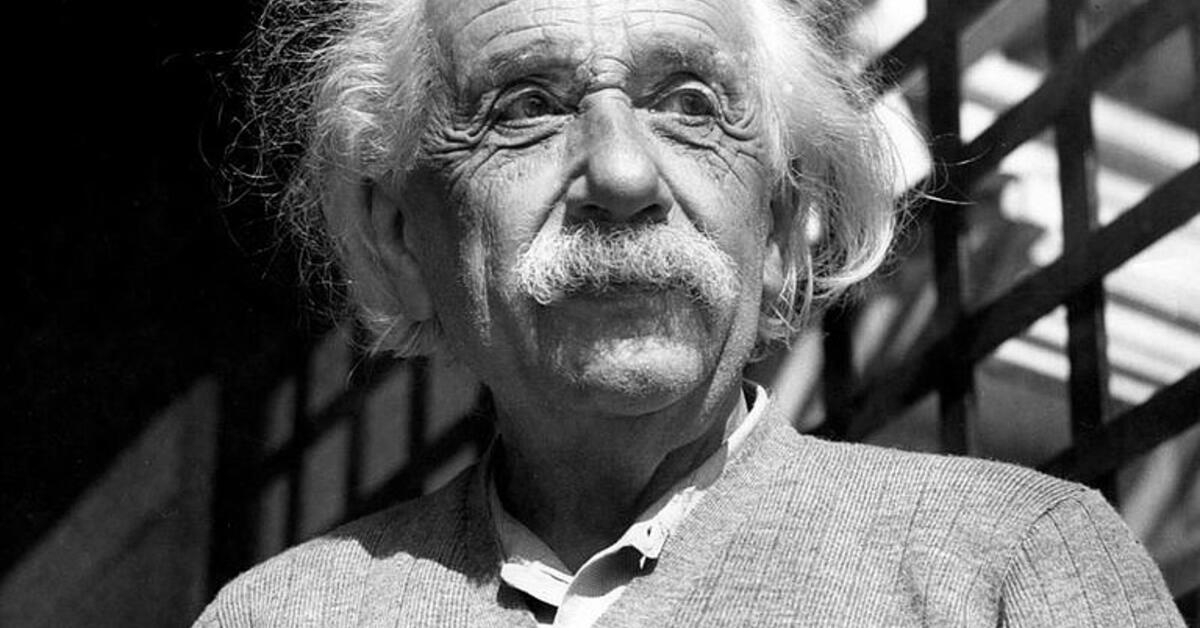
Here is a clear picture of Albert Einstein. He looks thoughtful, just like when he was thinking about the quantum world.
Who Was Albert Einstein?
Albert Einstein was born in 1879 in Germany. As a boy, he asked big questions like “What would happen if I rode on a beam of light?” He worked in a patent office in Switzerland, where he had time to think.
In 1905, he wrote several famous papers. One explained the photoelectric effect, which later won him the Nobel Prize. Another gave us E=mc², showing energy and mass are the same thing. Einstein believed the universe follows strict laws. He did not like chance or luck in science.
Einstein moved to America in 1933 because of the war in Europe. He lived in Princeton and kept working until he died in 1955. Many people call him the greatest scientist ever. Yet when quantum ideas came, he felt unhappy. He said the theory felt incomplete. This unhappiness started the long story of Einstein vs. Niels Bohr: The Greatest Battle over Quantum Mechanics.
Einstein wrote letters to friends saying the new quantum rules looked weird. He wanted a theory that told exact stories, not just chances. His famous line was “God does not play dice with the universe.” That line became the heart of the fight.
Who Was Niels Bohr?
Niels Bohr was born in 1885 in Denmark. He studied in Copenhagen and later in England with famous scientists. In 1913, he made a model of the atom that explained why electrons stay in certain orbits. This model mixed old physics with new quantum ideas.
Bohr won the Nobel Prize in 1922. He believed the tiny world of atoms works differently from the big things we see every day. His “Copenhagen interpretation” said we cannot know everything at once. Position and speed, for example, cannot both be known exactly. This idea shocked many people.
Bohr was kind and loved discussions. He built a big institute in Copenhagen where young scientists came to learn. He thought quantum mechanics was complete and beautiful, even if it felt strange. Bohr and Einstein became good friends but argued a lot. Their friendly fights made science move forward.

This painting shows Niels Bohr with the atom model he helped create.
In Einstein vs. Niels Bohr: The Greatest Battle over Quantum Mechanics, Bohr defended the new rules while Einstein kept asking for more proof. Their respect for each other never died, even when they disagreed strongly.
How Quantum Mechanics Was Born
Before 1900, scientists thought the world worked like clockwork. Newton’s laws explained planets and apples. Then problems appeared. Hot objects gave off light in ways old math could not explain. Max Planck said energy comes in small packets called “quanta.”
In 1905, Einstein explained light as particles (photons). Later, Louis de Broglie said matter can act like waves. Werner Heisenberg made “matrix mechanics,” and Erwin Schrödinger gave the wave equations. Suddenly, the atom world looked fuzzy and probabilistic.
Bohr helped put these pieces together. He said when we measure something, the act of measuring changes it. Einstein read these papers and felt worried. He believed nature should be real and local – meaning things happen here because of stuff right here, not far away instantly.
This worry grew into Einstein vs. Niels Bohr: The Greatest Battle over Quantum Mechanics. The two men wanted the same thing: truth. But they saw truth in different ways.
Einstein vs. Niels Bohr: The Greatest Battle over Quantum Mechanics really heated up at big meetings of top scientists.
The Famous Solvay Conferences
Every few years, rich businessman Ernest Solvay invited the best physicists to Brussels. The 1927 conference is still called the most intelligent photo ever taken. Einstein and Bohr sat together with 27 other geniuses, including Marie Curie and Max Planck.
.jpg)
Look at this famous colorized photo from the 1927 Solvay Conference. Einstein sits in the middle row, third from right. Bohr is in the second row, fifth from right. They look calm, but big arguments have happened inside.
At these meetings, Einstein tried clever thought experiments to show that quantum mechanics had problems. Bohr answered every time with clear logic. One story says Einstein woke Bohr at night with a new puzzle, and by breakfast, Bohr had the answer.
Einstein vs. Niels Bohr: The Greatest Battle over Quantum Mechanics became public here. Einstein said the theory must be incomplete. Bohr said it was fine,e and we just need to accept the strange rules.
They kept writing letters after the meetings. Einstein sent ideas, Bohr replied patiently. Their friendship stayed strong, but the ideas stayed apart.
The Core Disagreement: Reality and Chance
Einstein wanted a theory where everything has a real value,ue even when we do not look. Bohr said the value only appears when we measure. Before measurement, things exist in many possible states at once – called superposition.
Einstein hated that. He thought the mowas were there even if there were no lookouts. Bohr agreed that the moon is there, but tiny particles are different.
Another point was “locality.” Einstein believed nothing can travel faster than light. Yet quantum rules seemed to allow instant connections across distance. Einstein called this “spooky action at a distance.”
Einstein vs. Niels Bohr: The Greatest Battle over Quantum Mechanics was really about these two big ideas: realism and locality versus the Copenhagen view.
Einstein kept saying the theory is not complete. There must be hidden variables we cannot see yet that explain everything neatly. Bohr said no hidden variables exist; the rules are complete.
The EPR Paradox – Einstein’s Big Attack
In 1935, Einstein, Podolsky, and Rosen wrote a famous paper. They created a thought experiment now called EPR. Imagine two particles created together that fly apart. Measure one, and you instantly know about the other, no matter how far.
If the particles are far, how does the second one “know” instantly? Einstein said this proves quantum mechanics is incomplete or allows faster-than-light signals, which breaks special relativity.
Bohr answered quickly. He said the two particles form one system. Measuring one changes the whole system. No signal travels; the description is just different.
Einstein vs. Niels Bohr: The Greatest Battle over Quantum Mechanics reached its peak with the EPR paper. Newspapers wrote stories about it. Scientists everywhere discussed it for years.
This clear diagram shows the EPR idea. Two particles split and stay connected strangely.
The paradox did not kill quantum mechanics. Instead, it made scientists think harder and test more.
Bohr’s Strong Defense
Bohr used the idea of complementarity. He said some things, like wave and particle, are both true, but you cannot see both at the same time. The measuring tool decides what you see.
Bohr also said Einstein’s thought experiments had small mistakes. When you fix the details, quantum rules still hold.
Their letters went back and forth for decades. Einstein never gave up. Even on his deathbed, he thought about these questions.
Einstein vs. Niels Bohr: The Greatest Battle over Quantum Mechanics taught the world that good arguments push science forward. Neither man was “wrong.” They just saw different parts of the truth.
Later Tests: Bell’s Inequality and Real Experiments
In 1964, John Bell found a way to test the hidden variables idea with math. He created inequalities. If hidden variables exist, numbers must stay below a limit. Quantum mechanics predicts higher numbers.
In 1982, Alain Aspect did the first real test in Paris. He used photons and showed that quantum mechanics wins. The particles really act connected instantly.
Later experiments closed all loopholes. In 2015, big teams in the Netherlands and elsewhere did “loophole-free” tests. Every time, quantum rules won.
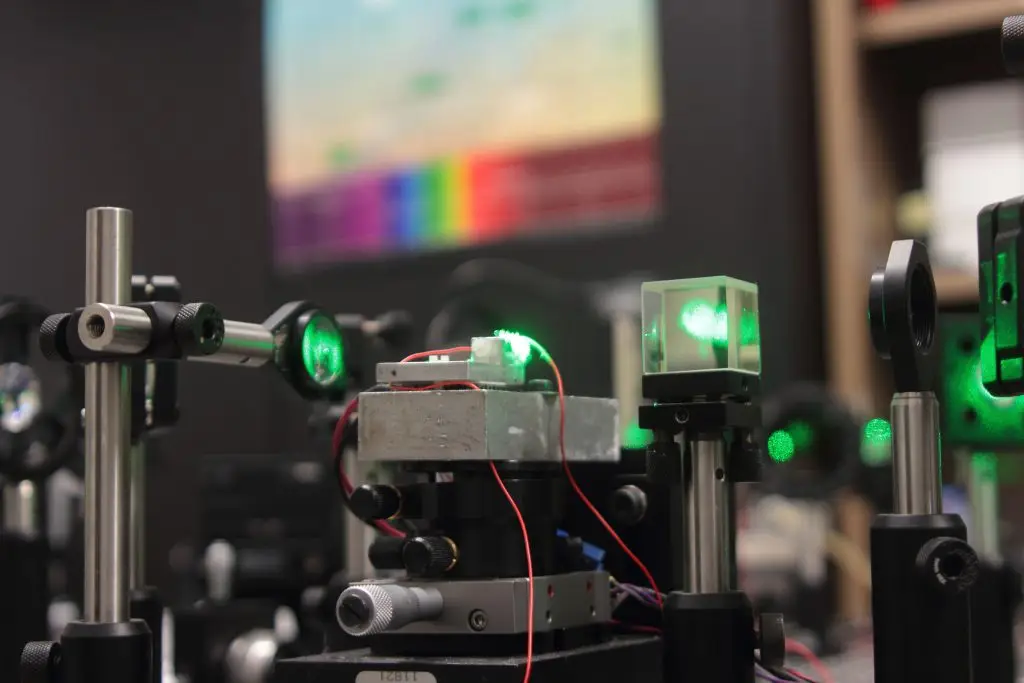
Here is a modern lab photo. Scientists use lasers and special detectors to test entanglement today, just like in those famous experiments.
Einstein vs. Niels Bohr: The Greatest Battle over Quantum Mechanics ended in a way: experiments proved Bohr’s side correct on the tests. But Einstein’s questions led to these tests, so he still helped science.
Today, most physicists accept that quantum mechanics works perfectly. Yet some still look for deeper theories, showing Einstein’s spirit lives on.
What Does This Battle Mean for Us Today?
Quantum mechanics now powers real things. Your phone uses quantum ideas in chips. GPS satellites need relativity and quantum clocks. Quantum computers solve problems that normal computers cannot.
Entanglement helps quantum cryptography – super safe codes that cannot be hacked. Hospitals use quantum ideas in MRI machines.
Einstein vs. Niels Bohr: The Greatest Battle over Quantum Mechanics gave us these gifts. Without the fight, we might not have pushed so hard to understand and use the rules.
Philosophers still argue about what quantum means for free will, consciousness, and reality. Books, movies, and podcasts keep telling the story.
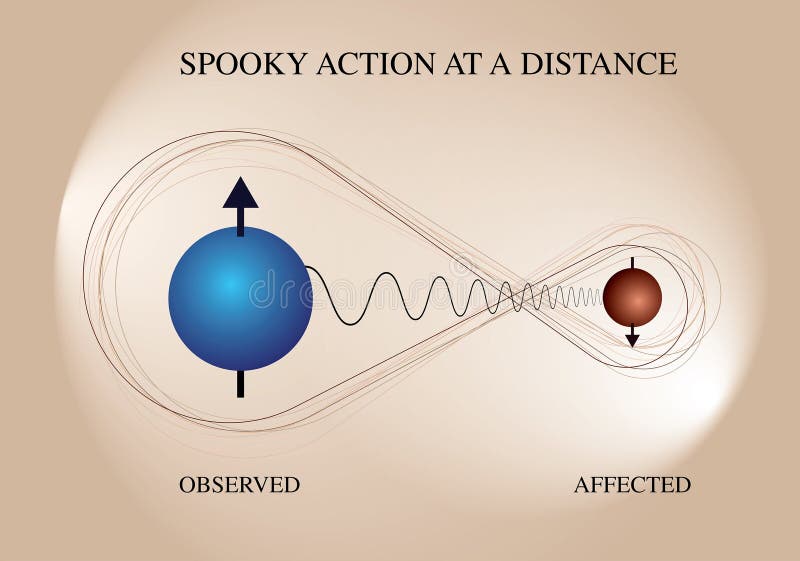
This simple drawing explains “spooky action at a distance” – the idea that made Einstein uncomfortable but powers new technology.
Schools teach the story to children to show that science grows through debate. Young students learn that even geniuses disagree and that is okay.
Why the Battle Still Inspires New Scientists
Many young physicists say the Einstein-Bohr story made them choose science. They see that big questions are still open. String theory, loop quantum gravity, and other ideas try to combine quantum rules with gravity – something Einstein dreamed of.
Einstein vs. Niels Bohr: The Greatest Battle over Quantum Mechanics reminds us that science is not finished. New tools like quantum telescopes or better computers may bring more surprises.
The battle also shows friendship and respect. Einstein and Bohr wrote warm letters even while arguing. They visited each other’s homes. This teaches us how to disagree nicely.
More Details on Key Thought Experiments
Let us look closer at one Einstein puzzle. Imagine a box with a clock and a photon inside. The clock opens a shutter at the exact time and lets one photon out. Bohr showed that measuring the box’s energy changes the clock time because of gravity and uncertainty. Einstein’s idea had a flaw.
Another puzzle: the double-slit experiment. Send electrons one by one. They make wave patterns until you watch which slit they use. Then the pattern disappears. Bohr said watching forces a choice. Einstein wanted both position and path.
These simple examples fill textbooks and help students understand why the debate was so deep.
How the Debate Changed Philosophy
Before quantum mechanics, most people believed in a clockwork universe. After the fight, many accepted that chance is built into nature. Philosophers like Karl Popper and others wrote about it.
Some people worry that quantum ideas mean nothing is real. Bohr said the world is real; our knowledge of it is limited. Einstein said we can know more.
Einstein vs. Niels Bohr: The Greatest Battle over Quantum Mechanics still appears in philosophy classes. Students debate: Is the moon there when nobody looks? The answer depends on whose side you are on.
Modern Applications Step by Step
- Quantum sensors measure tiny gravity changes for better maps.
- Quantum internet plans use entanglement to send data safely across cities.
- Drug companies use quantum computers to test new medicines faster.
Each step traces back to the rules Bohr defended and the questions Einstein asked.
Einstein vs. Niels Bohr: The Greatest Battle over Quantum Mechanics lives inside every quantum lab today.
Personal Stories and Fun Facts
Bohr once drew cartoons of Einstein’s thought experiments. Einstein laughed but kept trying. At one conference, Bohr said Einstein’s box would need quantum gravity effects he had ignored.
Einstein told friends he would rather be a shoemaker than accept chance in physics. Bohr replied that Einstein should stop telling God what to do.
These human moments make the big ideas easier to remember.
Timeline of the Battle
- 1913: Bohr’s atomic model
- 1927: First big Solvay fight
- 1935: EPR paper
- 1955: Einstein dies, still thinking about it
- 1964: Bell’s math
- 1982: Aspect experiment
- 2015: Loophole-free tests
Each date shows how Einstein vs. Niels Bohr: The Greatest Battle over Quantum Mechanics stretched across decades.
What If Einstein Had Been Right?
Some scientists still search for hidden variables. If they find them, quantum computers might need new designs. But so far, experiments say no.
The search itself creates new math and tools. So even “losing” the debate helped science win.
Einstein vs. Niels Bohr: The Greatest Battle over Quantum Mechanics proves that asking hard questions is the best way to move forward.
Lessons for Everyday Life
We can learn from them. When you face a hard problem, argue with friends respectfully. Accept that some things stay uncertain. Keep asking “why” like Einstein. Stay open to new rules like Bohr.
Parents can tell kids this story to encourage curiosity. Teachers use it to show science is alive.
Final Thoughts
The world is richer because two great men spent years arguing about tiny particles. Their battle gave us new technology, deeper philosophy, and better experiments. We still feel the effects in labs, classrooms, and phones.
Einstein vs. Niels Bohr: The Greatest Battle over Quantum Mechanics is not just old history. It is a living story that keeps inspiring new discoveries. Next time you see a laser or use GPS, remember the two friends who fought over how the universe really works.
Thank you for reading this long journey. Keep asking questions – that is how science grows.
Einstein vs. Niels Bohr: The Greatest Battle over Quantum Mechanics showed us the power of ideas and friendship in science.
Einstein vs. Niels Bohr: The Greatest Battle over Quantum Mechanics changed physics forever.
Einstein vs. Niels Bohr: The Greatest Battle over Quantum Mechanics remains one of the greatest stories in human thought.
Disclaimer
This article is written for educational and informational purposes only. It explains historical events, scientific ideas, and simple concepts in easy English. The content is based on well-known facts from physics history. It is not medical, legal, or professional advice. Always check with experts for deep scientific questions.
FAQs
Q1: Who won Einstein vs. Niels Bohr: The Greatest Battle over Quantum Mechanics? Experiments support Bohr’s view, but Einstein’s questions led to those tests. So both won in different ways.
Q2: What does “God does not play dice” mean? Einstein used it to say he hated random chance in quantum rules. He wanted exact laws.
Q3: Is quantum entanglement real? Yes. Many experiments prove it. It powers new technology but cannot send messages faster than light.
Q4: Can I understand quantum mechanics without math? Yes! Use simple pictures and stories like the ones in this article. The main ideas are about uncertainty and connections.
Q5: Why is this battle still important? It helps us build quantum computers and think about reality. New papers still discuss EPR ideas.
Q6: Where can I learn more? Watch videos on YouTube or read easy books like “Quantum” by Manjit Kumar.
Q7: Did Einstein and Bohr stay friends? Yes. They respected each other until the end. Their letters show warmth even during strong disagreement.
References
- Wikipedia – Bohr–Einstein debates (en.wikipedia.org/wiki/Bohr–Einstein_debates)
- Manjit Kumar, “Quantum: Einstein, Bohr and the Great Debate About the Nature of Reality” (2008)
- Walter Isaacson, “Einstein: His Life and Universe” (2007)
- Niels Bohr’s collected works and letters
- Alain Aspect’s 1982 paper on Bell tests
- 2015 loophole-free Bell test papers (Nature journal)
- Solvay Conference archives and photos
- John Bell’s 1964 paper on hidden variables
- Popular science sites like PBS Space Time and MinutePhysics videos
- “Einstein and the Quantum” by A. Douglas Stone (2013)
These sources helped build the simple explanations you just read. Check them for deeper details and pictures. Enjoy exploring the wonderful world of quantum ideas!
