

Unraveling the Role of Evil in Abrahamic Faiths: A Clear Guide to Spiritual Adversaries
Many believers and curious minds today seek to understand spiritual forces that influence human life. Religions shape how people view good and evil, and one key figure often discussed is the adversary who tempts or tests humans.
When exploring the difference between the Devil in Judaism, Christianity, and Islam, it becomes clear that this concept varies greatly across these three major faiths. Each religion has its own scriptures, stories, and teachings that paint a unique picture. This article breaks everything down in simple words so anyone can follow. We will examine the origins, stories, roles, and impacts in a step-by-step approach.
The difference between the Devil in Judaism, Christianity, and Islam helps explain why believers act differently in daily life, prayer, and moral choices.

The image above shows a classic artistic view of temptation in the Garden of Eden, a story shared across faiths but interpreted in very different ways.
The Devil in Judaism: An Accuser, Not a Rebel
In Judaism, the idea of the Devil is not like a powerful evil king fighting God. The Hebrew word "Satan" simply means "accuser" or "adversary." He is not a fallen angel who rebelled. Instead, he works as part of God's system, like a prosecutor in a heavenly court.
The Book of Job in the Tanakh (Jewish Bible) gives the clearest example. Satan appears before God and questions Job's faithfulness. God allows Satan to test Job by taking away his wealth, family, and health. But Satan never acts alone—he always needs God's permission. Job stays faithful, showing that tests strengthen faith.
In other parts of the Hebrew Bible, Satan appears only a few times, such as in Zechariah, where he accuses the high priest. There is no story of Satan being thrown out of heaven for pride. The serpent in the Garden of Eden story is just a clever animal, not linked to Satan.
Jewish teachings often see Satan as a symbol for the "yetzer hara," the evil inclination inside every person. Rabbis teach that humans have two inclinations—one good and one bad—and we must choose the good. In modern Judaism, many view Satan as a metaphor rather than a real being. Kabbalah (mystical Judaism) sometimes describes him as a force that accuses souls after death.
This view maintains that God is fully in control. Evil is not a separate power; it serves a purpose in God's plan. Jews focus more on following commandments (mitzvot) to overcome inner struggles than on fighting an external Devil.
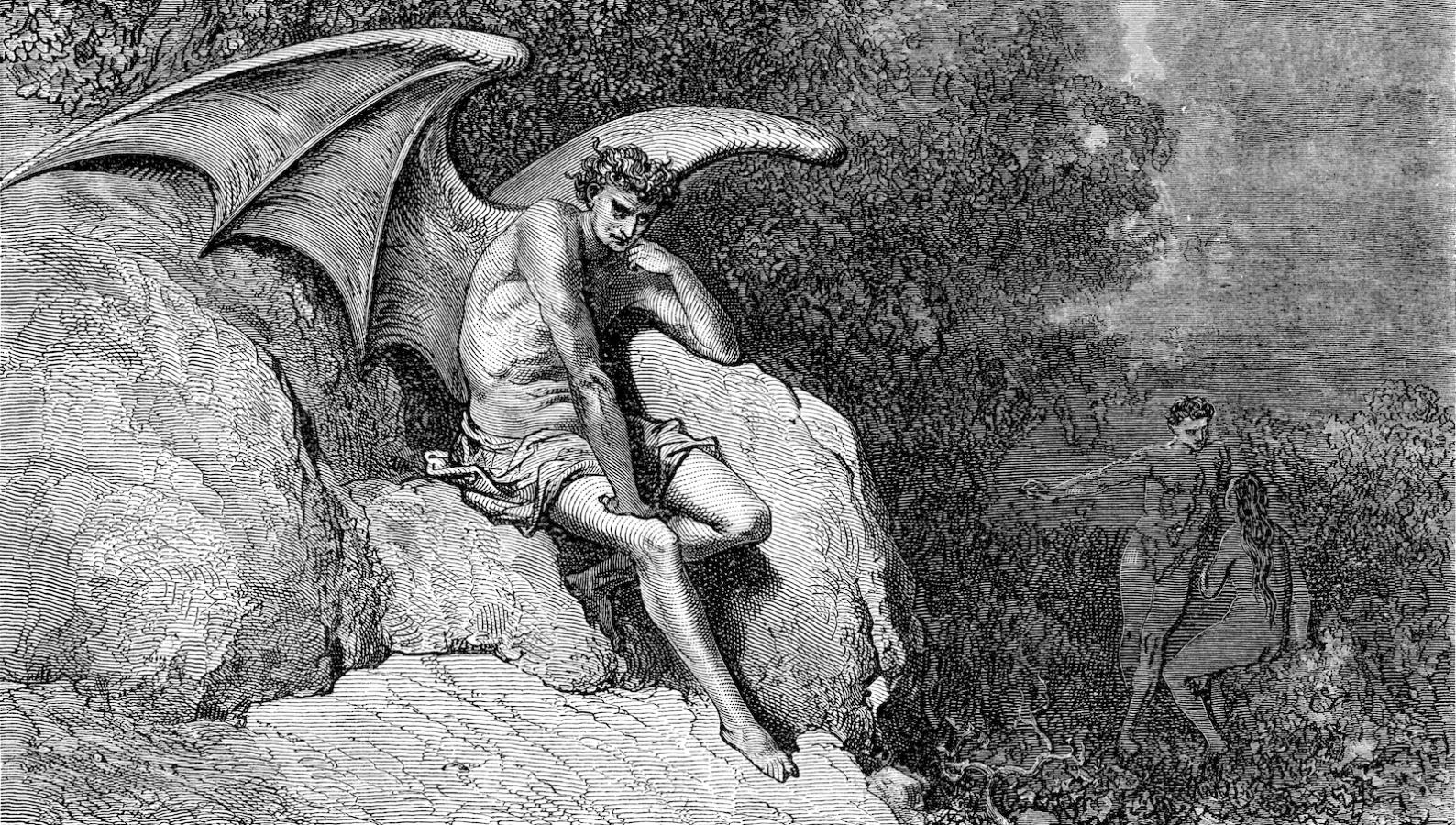
The picture here illustrates Satan in the Book of Job tradition, showing him as a winged accuser testing a faithful man.
Jewish history shows this idea developed over time. Early texts had no strong evil figure. Later, during the time of Persian rule, some influences from other cultures appeared, but mainstream Judaism kept Satan subordinate. Today, in synagogues and homes, you rarely hear sermons about battling the Devil. Instead, the focus stays on justice, charity, and repairing the world (tikkun olam).
Understanding this helps show the difference between the Devil in Judaism, Christianity, and Islam. In Judaism, he tests but never rules evil forces independently.
The Devil in Christianity: The Fallen Rebel and Tempter
Christianity presents a very different picture. Here, the Devil is Satan, also called Lucifer or the Devil. He is a fallen angel who rebelled against God out of pride. Scriptures link him to the serpent in Eden, the morning star that fell (Isaiah 14), and a dragon in Revelation.
In the New Testament, Satan tempts Jesus in the desert, offering him power if he worships him. Jesus refuses. Satan also enters Judas to betray Jesus and causes illness or possession in some stories. Christians believe he rules demons and influences the world until Jesus returns.
The fall story comes from church traditions based on Bible hints. Lucifer was once a beautiful angel, but he wanted to be like God. He and other angels were cast out of heaven. Now he tries to pull humans away from God through lies, temptation, and sin.
In books like Dante's Inferno or Milton's Paradise Lost, Satan appears as a tragic yet evil figure leading hell. Medieval Christians feared him greatly, leading to witch hunts and exorcisms. Today, many churches teach that Satan is real and active. Believers pray for protection, use holy water, or perform deliverance services.
Revelation describes the final battle: Satan is bound for 1,000 years, then defeated forever in the lake of fire. This gives hope—evil loses in the end.
Different Christian groups vary slightly. Catholics emphasize spiritual warfare and saints fighting demons. Protestants often see Satan as a deceiver in everyday life, such as through greed or addiction. Some modern Christians view him more symbolically as human evil.

This classic illustration captures the fallen Satan in Christian art, showing his dramatic and powerful image as the adversary.
Clearly, the difference between the Devil in Judaism, Christianity, and Islam stands out here. Christianity gives Satan much more power and independence as a rebel who leads a war against God.
Christian culture is full of Devil references—in movies like The Exorcist, music, and holidays like Halloween. This makes the figure very alive for billions of followers worldwide. The focus is on salvation through Jesus to escape Satan's traps.
The Devil in Islam: Iblis the Jinn and Whisperer
Islam calls the main adversary Iblis or Shaytan. He is not a fallen angel but a jinn made from smokeless fire. Jinn are invisible beings with free will, unlike angels, who obey perfectly.
The Quran tells the story clearly: God created Adam from clay and ordered all angels and jinn to bow in respect. Iblis refused, saying he was better because fire is superior to clay. God cast him out. Iblis begged for time until Judgment Day to mislead humans. God allowed it as a test for humanity.
Iblis now whispers evil suggestions (waswas) to people, tempting them to sin, forget God, or feel arrogant. He does not force anyone—humans choose. The Quran says Shaytan is an open enemy, but believers who remember God stay safe.
Unlike Christianity, Iblis is not the source of all evil. God controls everything, and evil serves as a test. Iblis will be punished in hell at the end. Hadith stories add details, like Iblis entering the serpent to tempt Adam and Eve in paradise.
Muslims say "A'udhu billahi min ash-shaytan ir-rajim" (I seek refuge with God from the accursed Satan) many times a day. During Ramadan or prayer, protection increases. Sufi mystics sometimes see Iblis as a tragic figure who loved God too much to bow to anyone else, but mainstream Islam views him as arrogant.
In Islamic art and stories, Iblis appears in old Persian miniatures as a dark, winged being with a tail. Modern Muslims focus on inner jihad—fighting personal temptations—more than external battles.

The beautiful Islamic miniature above shows Iblis refusing to bow before Adam, a central scene in the Quran story.
This makes the difference between the Devil in Judaism, Christianity, and Islam very clear again. In Islam, Iblis is a created being who tests faith through whispers, not a cosmic rebel or simple accuser.
Origins: The Difference Between the Devil in Judaism, Christianity, and Islam
One major part of the difference between the Devil in Judaism, Christianity, and Islam lies in their origins. Judaism starts with Satan as a heavenly job role—no rebellion story. Christianity adds the fall of Lucifer from Old Testament hints and New Testament drama. Islam introduces Iblis as a proud jinn, not an angel, with a direct Quran command to bow.
These origins come from different historical times. Judaism kept a strict monotheism where God alone creates everything, including tests. Christianity blended Jewish roots with ideas of spiritual war. Islam returned to the pure oneness of God (tawhid), making Iblis just one creature among many.
Nature and Power: The Difference Between the Devil in Judaism, Christianity, and Islam
The difference between the Devil in Judaism, Christianity, and Islam also shows in their nature. Jewish Satan has limited power and stays loyal to God. Christian Satan is powerful, leads armies of demons, and actively fights God until defeated. Islamic Iblis has influence but only through permission and whispers—he cannot create evil himself.
In Judaism, he is almost like a divine employee. In Christianity, he is a tragic villain. In Islam, he is a warning example against pride.
Role in Human Life: The Difference Between the Devil in Judaism, Christianity, and Islam
Another key to the difference between the Devil in Judaism, Christianity, and Islam is the daily role. Jews see inner struggle and use prayer plus good deeds. Christians battle through faith in Jesus and spiritual armor (Ephesians 6). Muslims recite Quran verses, say refuge prayers, and fast to weaken Shaytan.
Each faith teaches that victory is possible, but the path differs.
Temptation Stories and the Serpent
All three share the Adam and Eve tale but explain the serpent differently. Judaism: plain animal. Christianity: Satan in disguise. Islam: Iblis using the snake. This highlights the difference between the Devil in Judaism, Christianity, and Islam in how temptation works.
Cultural Impact and Modern Views
The difference between the Devil in Judaism, Christianity, and Islam affects art, movies, and society. Christianity has rich Devil imagery in paintings and films. Islam avoids most pictures of prophets but has historical miniatures of Iblis. Judaism keeps it abstract.
Today, some Christians see Satan in politics or disasters. Muslims link Shaytan to modern distractions like social media. Jews focus on human responsibility. Scholars note Zoroastrian influences on all, but each faith adapted uniquely.
The difference between the Devil in Judaism, Christianity, and Islam inspires interfaith dialogue. People learn tolerance by studying shared roots and unique teachings.
The difference between the Devil in Judaism, Christianity, and Islam appears in how evil is explained: internal in Judaism, external rebel in Christianity, test from a jinn in Islam.
The difference between the Devil in Judaism, Christianity, and Islam matters for understanding global conflicts and personal faith journeys.
The difference between the Devil in Judaism, Christianity, and Islam is studied in universities worldwide.
The difference between the Devil in Judaism, Christianity, and Islam shows God's sovereignty in different lights.
The difference between the Devil in Judaism, Christianity, and Islam helps believers choose paths of goodness.
The difference between the Devil in Judaism, Christianity, and Islam is a topic of endless fascination.
The difference between the Devil in Judaism, Christianity, and Islam teaches humility and reliance on the Creator.
The difference between the Devil in Judaism, Christianity, and Islam reminds us that evil is real but not equal to God.
The difference between the Devil in Judaism, Christianity, and Islam encourages the study of holy books for wisdom.
In conclusion, the difference between the Devil in Judaism, Christianity, and Islam reveals beautiful diversity in how humanity understands challenge and choice. By learning these views, we grow in respect and knowledge. The core message stays the same across faiths: choose good, trust God, and overcome temptation.
Disclaimer
This article is written for educational and informational purposes only. It aims to explain religious concepts in simple language based on traditional sources. It does not intend to criticize, convert, or offend any faith. Interpretations of religious texts can vary among scholars and communities. Always consult qualified religious leaders or original scriptures for personal guidance. The author and publisher are not responsible for any misuse or misunderstanding of the content.
FAQs
Q1: What is the main focus when studying the difference between the Devil in Judaism, Christianity, and Islam? A: It helps show how each faith views temptation, evil, and God's control differently while sharing Abrahamic roots.
Q2: Does the difference between the Devil in Judaism, Christianity, and Islam mean one religion is right? A: No. Each faith has its own beautiful teachings. The differences enrich understanding rather than create conflict.
Q3: How does the difference between the Devil in Judaism, Christianity, and Islam affect daily prayers? A: Jews focus on good deeds, Christians on Jesus' protection, and Muslims on refuge prayers and Quran recitation.
Q4: Is there any similarity despite the difference between the Devil in Judaism, Christianity, and Islam? A: Yes—all see the adversary as limited by God, and all teach that humans can overcome through faith and good actions.
Q5: Why is the difference between the Devil in Judaism, Christianity, and Islam important today? A: It promotes tolerance in multicultural societies and helps explain cultural stories, art, and beliefs worldwide.
Q6: Can children understand the difference between the Devil in Judaism, Christianity, and Islam? A: Yes, when explained simply as a tester (Judaism), rebel (Christianity), or whisperer (Islam).
Q7: Where can I learn more about the difference between the Devil in Judaism, Christianity, and Islam? A: Read the Bible, Tanakh, and Quran directly, or books by scholars. Visit places of worship respectfully.
References
- Wikipedia: Satan (detailed entries on Abrahamic portrayals)
- Wikipedia: Iblis (Quranic and Hadith summaries)
- Wikipedia: Devil (comparative sections across faiths)
- Huneidi, H. (2014). A Historical Account of the Conceptual Evolution of Satan. Dominican University scholarly thesis.
- My Jewish Learning: Articles on Satan the Adversary.
- Britannica entries on Job and biblical figures.
- Medium and academic sources on Islamic art and Shaytan.
- Quranic verses (e.g., Surah Al-Baqarah 2:34, Surah Al-Hijr 15:39) and Biblical references (Job 1-2, Revelation 12).
All information is drawn from respected religious texts and scholarly overviews for accuracy and respect.
